
- ホーム
- > 電子洋書
Description
This book analyzes how Japan, Taiwan, South Korea, and China achieved rapid economic development through public policies and technological innovation in East Asia. The work examines the fundamental role of the state and industrial strategies in the process of technological catching-up in these economies. Throughout its chapters, the author explores the historical foundations and economic policies of each country under global geopolitical pressures. The book begins with two chapters addressing the economic rise of East Asia and the main heterodox developmental literatures, followed by four chapters discussing these specific experiences (Japanese, Taiwanese, South Korean, and Chinese), and finally, a comparative conclusion. Finally, the analysis focuses on the role of state-owned enterprises, government planning, and technical bureaucracies in sustaining growth. Written in clear and accessible language, this book is essential for researchers, students, and anyone interested in understanding the role of the state and the lessons of Asian development for the contemporary global landscape.
Table of Contents
Chapter 1: Late Industrialization in Historical Perspective and Development Dynamics in Post-War Asia.- Chapter 2 : The Japanese Case The political economy of two technological Catching-ups.- Chapter 3:The Taiwanese Case: the political economy of the Guomindang’s (KMT) second chance.- Chapter 4 :The South Korean Case The political economy of the Miracle on the Han River.- Chapter 5 :The Chinese Case The political economy of the Middle Kingdom.- Chapter 6:Similarities and Particularities of Historical Development Experiences and the Limits of Literature.

-

- 洋書電子書籍
-
AIとともに戦略を考える
Str…
-
- 洋書電子書籍
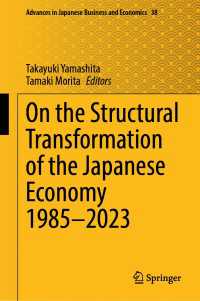
- 山下隆之・森田玉雪(共)編/日本経済の…





