
Description
This book is written in a clear and thorough way to cover both the traditional and modern uses of artificial intelligence and soft computing. It gives an in-depth look at mathematical models, algorithms, and real-world problems that are hard to solve in MATLAB. The book is intended to provide a broad and in-depth understanding of fuzzy logic controllers, genetic algorithms, neural networks, and hybrid techniques such as ANFIS and the GA-ANN model.
Features:
- A detailed description of basic intelligent techniques (fuzzy logic, genetic algorithm and neural network using MATLAB)
- A detailed description of the hybrid intelligent technique called the adaptive fuzzy inference technique (ANFIS)
- Formulation of the nonlinear model like analysis of ANOVA and response surface methodology
- Variety of solved problems on ANOVA and RSM
- Case studies of above mentioned intelligent techniques on the different process control systems
This book can be used as a handbook and a guide for students of all engineering disciplines, operational research areas, computer applications, and for various professionals who work in the optimization area.
Table of Contents
Part A: Artificial Intelligence & Cognitive Computing : Theory &Concept
1. Introduction to AI
1.1 Introduction
1.1.1 Intelligent Control
1.1.2 Expert System
1.1.3 Soft Computing
1.1.3.1 Fuzzy System
1.1.3.2 Neural Network
1.1.3.3 Genetic Algorithm
1.1.3.4 Adaptive Fuzzy Inference System
1.1.4 Real-time System
Reference
2. Practical Approach of Fuzzy Logic Controller
2.1 Introduction
2.2 Classical set Properties & Operation
2.2.1 Classical Set
2.2.2 Crisp Set
2.3 Concept of Fuzzy
2.3.1 Fuzzy Set
2.3.2 Operation of Fuzzy Set
2.3.3 Properties of Fuzzy Set
2.3.4 Comparison between Crisp Set & Fuzzy set
2.3.5 Composition of Fuzzy Set
2.3.6 Properties of Fuzzy Composition
2.3.7 Classical tolerance Relation
2.3.8 Features of membership function
2.4 Fuzzification
2.4.1 Intitution
2.4.2 Inference
2.4.3 Rank Ordering
2.4.4 Angular Fuzzy set
2.4.5 Neural network
2.4.5.A Training the neural network
2.4.5.B Testing the neural network
2.4.6 Genetic Algorithm
2.4.7 Inductive reasoning
2.5 Defuzzification
2.5.1 Max – membership principle
2.5.2 Centroid method
2.5.3 Weighted average method
2.5.4 Mean- max membership or middle of maxima
2.5.5 Center of sum methods
2.5.6 Center of largest area
2.6 Example for different Defuzzification methods
Reference
3. A Practical Approach to Neural Network Model
3.1 Introduction
3.1.1 Network Topology
3.1.1.A Feed forward Network
3.1.1.B. Feedback Network
3.1.2 Adjustments of Weights or Learning
3.1.2.1 Supervised Learning
3.1.2.2 Unsupervised Learning
3.1.2.3 Reinforcement Learning
3.1.3 Activation Functions
3.1.3.1 Type of Activation Function
3.1.4 Learning rules in neural network
3.1.4.1 Hebbian Learning Rule
3.1.4.2. Perceptron Learning Rule
3.1.4.3 Delta Learning Rule
3.1.4.4 Competitive Learning Rule (Winner-takes-all)
3.1.4.5 Outstar Learning Rule
3.1.5 Mcculloch Pitts neuron
3.1.6 Simple neural nets for pattern classification
3.1.7 Linear Reparability
3.1.8 Perceptron
3.2. Adaptive Linear Neuron (ADALINE)
3.2.1 Madaline (Multiple adaptive linear neurons)
3.2.2 Associative Memory Network
3.2.3 Hetero Associative memory
3.3 Bidirectional associative memory
3.4 Self-Organizing Maps: Kohonen Maps
3.5 Learning vector Quantization (LVQ)
3.6 Counter Propagation Network (CPN)
3.6.1 Full counter propagation network (FCPN)
3.6.2. Forward only counter Propagation network
3.7 ART (Adaptive resonance Theory)
3.8 Standard back propagation architecture
3.9 Boltzmann Machine Learning
Reference
4. Introduction to Genetic Algorithm
4.1 Introduction
4.2 Optimization Problems
4.2.1 Steps for solving the optimization problem
4.2.2 Point to point Algorithms (P2P)
4.2.3 A∗ Search Algorithm
4.2.4 Simulated Annealing
4.2.5 Genetic Algorithm
4.2.5.1 Motivation of GA
4.2.5.2 Basic Terminology
4.2.5.3 Experiments
4.2.5.4 Parameters Tuning Technique in Genetic Algorithm
4.2.5.5 Strategy parameters
4.3 Constrained Optimization
4.4 Multimodal optimization
4.5 Multiobjective Optimization
4.6 Combinatorial Optimization
4.6.1 Differential Evolution
Reference
5. Modeling of ANFIS (Adaptive Fuzzy Inference System) System
5.1 Introduction
5.2 Hybrid Systems
Sequential Hybrid Systems
5.2.2. Auxiliary Hybrid Systems
5.2.3 Embedded Hybrid Systems
5.3 Neuro-Fuzzy Hybrids
5.3.2 Adaptive Neuro-Fuzzy Interference System (ANFIS)
5.3.2.1 Fuzzy Inference System (FIS)
5.3.2.2 Adaptive Network
5.4 ANFIS Architecture
5.4.1 Hybrid Learning Algorithm
5.4.2 Derivation of Fuzzy Model
5.4.2.1 Extracting the initial fuzzy model
5.4.2.2 Subtractive Clustering Technique
5.4.2.3 Grid Partitioning Technique
5.3.2.4 C- Mean Clustering
Reference
6. Machine Learning Techniques for Cognitive Modeling
6.1 Introduction
6.2 Classification of Machine Learning
6.2.1 Supervised Learning
6.2.1.1 Inductive Learning
6.2.1.2 Learning by Version Space
6.2.1.3 Learning by Decision Tree (DT)
6.2.1.4 Analogical Learning
6.2.2 Unsupervised Learning
6.2.3 Reinforcement Learning
6.2.3.1 Learning Automata
6.2.3.2 Adaptive Dynamic Programming
6.2.3.3 Q learning
6.2.3.4 Temporal difference learning
6.2.4 Learning by Inductive Logic Programming (ILP)
Reference
Part B: Artificial Intelligence & Cognitive Computing : Practices
7. Parametric Optimization of N Channel JFET using Bio Inspired Optimization Techniques
7.1 Introduction
7.2 Mathematical Description
7.2.1 Current Equation for JFET
7.2.2 Flower Pollination Algorithm
7.2.3 Objective Function
7.3 Methodology
7.4. Result & Discussion
7.5 Conclusion
Reference
8. AI based Model of Clinical and Epidemiological Factors for COVID19
8.1 Introduction
8.2 Related Work
8.3 Artificial Neural Network Based Model
8.3.1 Modeling of Artificial Neural Network
8.3.1.1 Collection, pre-processing and division of data
8.3.1.2 Implementation of neural network
8.3.2 Performance of Training, Testing & Validation of network
8.3.3 Performance evaluation of Training Functions
8.4 Results & Discussion
8.5 Conclusions
Reference
9. Fuzzy Logic Based Parametric Optimization Technique of Electro Chemical Discharge Micro-Machining (µ-CDM) Process during Micro-Channel Cutting on Silica Glass
9.1 Introduction
9.2 Development of the Set up
9.3 Experimental Methodology & Result Analysis
9.3.1 Effects of process parameters on MRR, OC and MD
9.3.2 Determination of optimized condition
9.4 Conclusions
References
10. Study of ANFIS model to Forecast the Average Localization Error (ALE) with Applications to Wireless Sensor Networks (WSN)
10.1 Introduction
10.2 System Model
10.2.1 Distance calculation for generalization of Optimization problem
10.2.2 Simulation Setup
10.2.3 Experimental Results and Performance Analysis
10.2.3.1 The Effect of Anchor Density
10.2.3.2 The Effect of Communication Range
10.3 Adaptive Neuro-Fuzzy Inference Architecture
10.3.1 Hybrid Learning ANFIS
10.3.2 ANFIS Training Process
10.4 Result Analysis
10.5 Conclusions
References
11. Performance Estimation of Photovoltaic Cell using Hybrid Genetic Algorithm & Particle Swarm Optimization
11.1 Introduction
11.2 Mathematics model & objective function of the Solar Cell
11.2.1 Single diode model (SDM)
11.2.2 Double diode model (DDM)
11.2.3 PV module model
11.3 Objective function
11.4 Proposed Methodology
11.4.1 Improved Cuckoo Search Optimization
11.5 Results and Discussion
11.5.1 Test information
11.5.1.1 Fitness Test
11.5.1.2 Reliability Test
11.5.1.3 Computational Efficiency Test
11.5.1.4 Convergence Test
11.5.1.5 Accuracy Test
11.5.2 Overall Efficiency
11.5.3 Validation between manufacturer’s datasheet & experimental datasheets
11.5.3.1 Case study 1: Single diode model
11.5.3.2 Case study 2: Double diode model
11.6 Conclusions
References
12. Bio inspired Optimization based PID Controller Tuning for a Non-Linear Cylindrical Tank System
12.1 Introduction
12.2 Methodology
12.2.1 Mathematical model of Cylindrical Tank
12.2.2 Description of Metaheuristic techniques
12.2.2.1 Flower Pollination Algorithm (FPA)
12.2.2.2 Bacterial Foraging Optimization Algorithm (BFOA):
12.3 Result & Discussion
12.4 Conclusion
References
13. A Hybrid Algorithm Based on CSO & PSO for Parametric Optimization of Liquid Flow model
13.1 Introduction
13.2 Experimental Setup Liquid flow control process
13.3 Modeling of the liquid flow process
13.4 Proposed Methodology
13.4.1 Hybrid GAPSO
13.4.2 Parameters Setting
13.5 Performance Analysis
13.5.1 Computational Efficiency Test
13.5.2 Convergence Speed
13.5.3 Accuracy Test
13.6 Finding optimal condition for Liquid flow
13.7 Conclusions
References
14. Modelling of Improved Deep Learning Algorithm for Detection of Type 2 Diabetes
14.1 Introduction
14.2 Methodology
14.2.1 Datasets
14.2.2 Imbalance datasets
14.2.3 Synthetic Minority over Sampling Technique (SMOTE)
14.3 Proposed flow Diagram
14.4 Deep Neural Network for Data classification
14.5 Experimental Result Analysis
14.5.1 Performance Measure
14.5.2 Comparison with existing system
14.6 Conclusions
References
15. Human Activity Recognition (HAR), Prediction & Analysis using Machine Learning
15.1 Introduction
15.2 Related Works
15.3 Proposed Method for Human Action Recognition
15.3.1 Data Collection overview
15.3.2 Signal processing
15.3.3 Feature selection
15.3.4 Exploratory Data Analysis
15.3.5 Data preprocessing
15.3.6 Exploratory Data Analysis for Static and dynamic activities
15.3.7 Visualizing data using t-SNE
15.4 Machine learning Algorithm
15.4.1 Logistics Regression
15.4.2 Random Forest
15.4.3 Decision Tree
15.4.4 Support vector machine
15.4.5 K nearest neighbor
15.4.6 Naïve Bayes
15.4.7 Data preprocessing
15.5 Experimental Results
15.6 Conclusion
Reference

-

- 電子書籍
- 元男装令嬢と初恋こじらせ伯爵~ライバル…
-
- 洋書電子書籍
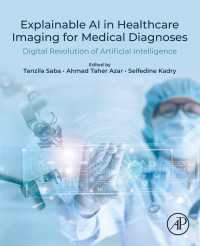
- Explainable AI in H…
-

- 洋書電子書籍
- Sustainable Water P…
-

- 洋書電子書籍
- Tuberculosis, An Is…
-

- 洋書電子書籍
- Hydrocarbons in Bas…



