
Description
Looks at the rollout of one of the largest infrastructure programs in human history to show how local governments play a complex role.China's high-speed railway network is one of the largest infrastructure programs in human history. Despite global media coverage, we know very little about the political process that led the government to invest in the railway program and the reasons for the striking regional and temporal variation in such investments. In Localized Bargaining, Xiao Ma offers a novel theory of intergovernmental bargaining that explains the unfolding of China's unprecedented high-speed railway program. Drawing on a wealth of in-depth interviews, original data sets, and surveys with local officials, Ma details how the bottom-up bargaining efforts by territorial authoritieswhom the central bureaucracies rely on to implement various infrastructure projectsshaped the allocation of investment in the railway system. Demonstrating how localities of different types invoke institutional and extra-institutional sources of bargaining power in their competition for railway stations, Ma sheds new light on how the nation's massive bureaucracy actually functions.
Table of Contents
DedicationAcknowledgementsAbbreviationsList of FiguresList of TablesChapter 1: IntroductionChapter 2: Bureaucracies and Localized BargainingChapter 3: Local Ambitions in Central PolicymakingChapter 4: The "Cardinals" and the "Clerics"Chapter 5: The Political Geography of High-speed RailwaysChapter 6: The Power of the MassesChapter 7: ConclusionBibliographyIndex

-
- 洋書電子書籍
-
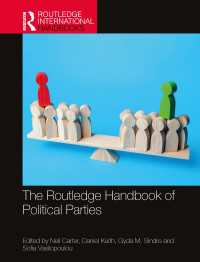
ラウトレッジ版 政党ハンドブック
-
- 洋書電子書籍
- ケンブリッジ版 保健調査の法規制ハンド…
-
- 洋書電子書籍
- 競争による変化:韓国にみる開発国家の進…
-
- 洋書電子書籍
- 国際金融におけるホームバイアスと地域愛…
-
- 洋書電子書籍
-
地政学と開発
Geopoliti…



