- ホーム
- > 洋書
- > 英文書
- > Literary Criticism
Full Description
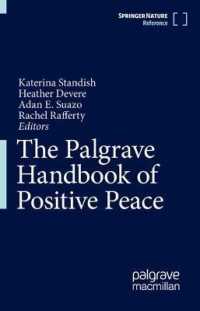
Adopting a unique historical approach to its subject and with a particular focus on the institutions involved in the creation, dissemination, and reception of literature, this handbook surveys the way in which the Cold War shaped literature and literary production, and how literature affected the course of the Cold War. To do so, in addition to more 'traditional' sources it uses institutions like MFA programs, university literature departments, book-review sections of newspapers, publishing houses, non-governmental cultural agencies, libraries, and literary magazines as a way to understand works of the period differently.
Broad in both their geographical range and the range of writers they cover, the book's essays examine works of mainstream American literary fiction from writers such as Roth, Updike and Faulkner, as well as moving beyond the U.S. and the U.K. to detail how writers and readers from countries including, but not limited to, Taiwan, Japan, Uganda, South Africa, India, Cuba, the USSR, and the Czech Republic engaged with and contributed to Anglo-American literary texts and institutions.
Contents
Introduction
SECTION 1: PRODUCTION
1. How the Communist Party Shaped Gwendolyn Brooks's Early Writing: Mary Helen Washington
2. The Cold War Encyclopedic Novel: Jeffrey Severs, University of British Columbia (Canada)
3. Cold War Technology and Women Poets: Linda Kinnahan, Duquesne University (USA)
4. The American Long Poem Evolves, 1945-1990: Ed Brunner, Southern Illinois University (USA)
5. Butler, Le Guin, and Feminist Science Fiction of the Cold War: Katlyn Williams, University of Iowa (USA)
6. Cold War Spy Fiction: Skip Willman, University of South Dakota
7. American Jewish Writers and the Eastern Bloc: Brian Goodman, Arizona State University (USA)
8. Writing the Cold War in the American Academic Novel: Ian Butcher, Fanshawe University (Canada)
SECTION II: CIRCULATION
9. Anglo-American Propaganda and the Transition from the Second World War to the Cultural Cold War: James Smith and Guy Woodward, Durham University (UK)
10. Book Diplomacy: Rósa Magnúsdóttir and Birgitte Beck Pristed, Aarhus University (Denmark)
11. Closets, Pulps, and the Gay Internationale: Jaime Harker, University of Mississippi (USA)
12. Librarians, Library Diplomacy, and the Cultural Cold War, 1950-1970: Amanda Laugesen, Australian National University (Australia)
13. The Transcription Centre and the Co-Production of African Literary Culture in the 1960s: Asha Rogers, University of Birmingham (UK)
14. Creative Writing and the Cold War: Eric Bennett, Providence College (USA)
15. How Chinese Letters Traveled to Iowa City: P Yi-hung Liu, Academia Sinica (Taiwan)
16. William Faulkner as Cold War Cultural Ambassador: Deborah Cohn, Indiana University (USA)
SECTION III: RECEPTION
17. The Distribution and Reception of American Literature in Cold War Japan: Hiromi Ochi, Senshu University, Tokyo (Japan)
18. Making a Literary Working Class in the Cultural Cold War: Nicole Moore, University of New South Wales (Australia)
19. Anti-Apartheid Imagination, the Cold War-era, and African Literary Magazines: Christopher Ouma, University of Cape Town (South Africa)
20. Cuban Revolutionaries Read U.S. Writers: Russell Cobb, University of Alberta (Canada)
21. "Cultural Freedom" in Cold War India: Laetitia Zecchini, CNRS Paris (France)
22. Robinson Jeffers's Journey behind the Iron Curtain: Jirina Smejkalova, Charles University, Prague (Czech Republic)
23. Reading for Freedom in Cold War America: Kristin Matthews, Brigham Young University (USA)


-

- 電子書籍
- 作家とお金(きずな出版)
-
- 電子書籍
- メイデーア転生物語 この世界で一番悪い…