
Description
The Han Dynasty, which ruled from 202 BCE to 212 CE, is often taken as a reference point and model for Chinese identity and tradition. Covering a geographical expanse comparable to that of the People's Republic of China, it is foundational to understanding Chinese culture and politics, past and present. This volume offers an up-to-date overview of the archaeology of the Han Empire. Alice Yao and Wengcheong Lam study the period via an interdisciplinary approach that combines textual and archaeological evidence. Exploring the dynamics of empire building in East Asia, Yao and Lam draw on recent archaeological discoveries to recast Western Han imperialism as a series of contingent material projects, including the organization of spatial orders, foodways, and the expansion of communication and ritual activities. They also demonstrate how the archaeology of everyday life offers insights into the impact of social change, and how people negotiated their identities and cultural affiliations as individuals and imperial subordinates.
Table of Contents
Introduction; Part I. Imperial Geography: 1. Imperial geography of the capital and core macro-regions; 2. Imperial geography and border formations in the Ordos and Lingnan regions; Part II. Food Production and Foodways: 3. Crop production in the Guanzhong Basin; 4. Crop production in the Yellow River valley and the New Territories; Part III. Crafts: 5. Craft production and consumption in the capital and Yellow River Macro-regions; 6. Craft production and consumption in the Hexi and Lingnan regions; Part IV. Death Ritual: 7. The (un)dead and the role of ritual in the crafting of sociopolitical networks; 8. Mourning practices and the cultivation of selves – views from the Hexi, Ordos, and Lingnan.

-

- 洋書電子書籍
-
社会行動統計学
Social B…
-
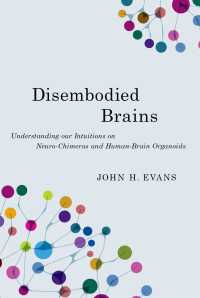
- 洋書電子書籍
-
脱身体化された脳の理解
Dise…
-

- 洋書電子書籍
-
音楽産業ハンドブック(第13版)
-
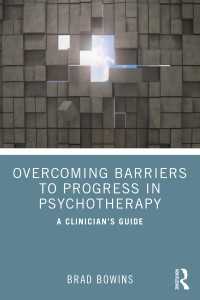
- 洋書電子書籍
-
精神療法における進展への障壁の克服
-

- 洋書電子書籍
-
文学研究と人類の繁栄
Liter…



