
- ホーム
- > 電子洋書
Description
This book is about law, but it is not a law book. It is aimed at all interested contemporaries, lawyers and non-lawyers alike. Richly seasoned with personal memories and anecdotes, it offers unique insights into how European courts actually work.
It is generally assumed that independence is part and parcel of the role and function of a judge. Nevertheless, European judges sometimes face difficulties in this regard. Owing to their being nominated by a government, their limited term of appointment, and the possibility of being reappointed or not, their judicial independence can be jeopardized. Certain governments have a track record of choosing candidates who they believe they can keep on a leash. When this happens, private parties are at risk of losing out.
The EFTA Court is under even more pressure, since the EEA/EFTA states Iceland, Liechtenstein and Norway essentially constitute a pond with one big fish (Norway) and two minnows. For quite some time now, certain Norwegian protagonists have sought to effectively transform the EEA into a bilateral agreement with the EU. This attitude has led to political implications that have affected the author himself.
The independence of the EFTA Court is also endangered by the fact that it operates alongside a large sister court, the Court of Justice of the European Union. And yet the EFTA Court has established its own line of jurisprudence and its own judicial style. It has remained faithful to specific EFTA values, such as the belief in free trade and open markets, efficiency, and a modern view of mankind. During the first 24 years of its existence, it has even had an over-proportionate influence on ECJ case law.
Since EEA Single Market law is economic law, the importance of economics, an often-overlooked aspect, is also addressed. In closing, the book explores Switzerlandâs complicated relationship with, and Britainâs impending departure from, the EU. In this regard, it argues that the EFTA pillar should be expanded into a second European structure under British leadership and with Swiss participation.
Table of Contents
Preface,-Prologue.-Chapter 1: My pre-court life,-Chapter 2: EFTA Court judge by chance,- Chapter 3: The EEA â One area with two courts,- Chapter 4: The legacy of the five-member Court,- Chapter 5: Resurrection from the dead,- Chapter 6: The Member States â an unholy alliance,-Chapter 7: ESA â the great negotiator,-Chapter 8: Preliminary references â all options open?,- Chapter 9: A matter of interpretation, - Chapter 10: War over constitutional principles,- Chapter 11: Two early landmark cases: Veronikaâs struggle and enriched cereals,- Chapter 12: Fundamental rights â the EFTA Court amends the law,- Chapter 13: Putting the EFTA Court on the map,- Chapter 14: The economics of EEA Single Market law,- Chapter 15: Fundamental freedoms and the cursed proportionality test,- Chapter 16: Competition law â a rare pleasure,- Chapter 17: State aid law â a mixed pleasure,- Chapter 18: Secondary law â a wide sphere,- Chapter 19: Free movement of persons and social policy,- Chapter 20: Whereâs the beef?,- Chapter 21: Judicial dialogue between the ECJ and the EFTA Court,- Chapter 22: The Norwegian social model on the brink of downfall?,- Chapter 23: The failed decapitation of Kong Carl,- Chapter 24: âRoom for manoeuvreâ for Norway!,- Chapter 25: The Icesave saga,- Chapter 26: Gunfight at the Oslo corral,- Chapter 27: Working methods and judicial style,- Chapter 28: Attack on the EFTA Courtâs integrity,- Chapter 29: The Commission â The EFTA Courtâs patron saint?,- Chapter 30: Switzerland â from EU-phobia to EU-philia?,- Chapter 31: Brexit â No to an âever closer Unionâ,- Chapter 32: âTwo souls in Europeâsbreast",- Epilogue.

-
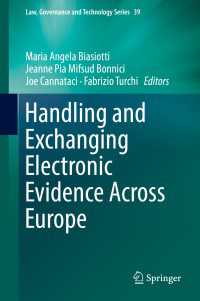
- 洋書電子書籍
- Handling and Exchan…
-

- 洋書電子書籍
-
情報公開法の国際比較
The R…
-
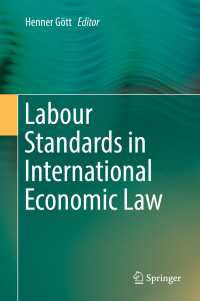
- 洋書電子書籍
- Labour Standards in…
-
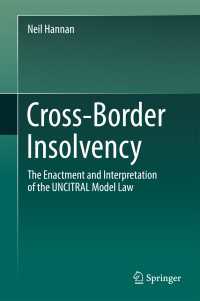
- 洋書電子書籍
- 国際倒産法:UNCITRALモデル法の…
-

- 洋書電子書籍
- 河野俊行編/知的所有権における担保権<…



