
Description
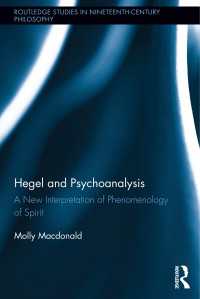
Hegel only published five books in his lifetime, and among them the Phenomenology of Spirit emerges as the most important but also perhaps the most difficult and complex. In this book Ludwig Siep follows the path from Hegel's early writings on religion, love and spirit to the milestones of his 'Jena period'. He shows how the themes of the Phenomenology first appeared in an earlier work, The Difference between Fichte's and Schelling's Systems of Philosophy, and closely examines the direction which Hegel's thought took as he attempted to think through the possibility of a complete system of philosophy. The themes encompassed by the Phenomenology - anti-dualistic epistemology, autonomy, historicality, the sociality of reason - are thoroughly discussed in Siep's subtle and elegantly argued assessment, which appears here in English for the first time. It will be of great interest to all readers studying Hegel's thought.
Table of Contents
Preface; Chronology; 1. The ambition of the Phenomenology of Spirit; 2. Hegel's philosophical development prior to the Differenzschrift; 3. The task and system of philosophy according to the Differenzschrift; 4. Hegel's philosophical development in Jena (1801–1806); 5. The task and method of the Phenomenology of Spirit; 6. The course of the Phenomenology of Spirit; 7. Impact.

-
- 洋書電子書籍
- 中国とキリスト教の最初の遭遇:史料から…
-
- 洋書電子書籍
-
ケンブリッジ版 ユダヤ教と法必携
-
- 洋書電子書籍
-
図書館のための地理資料ガイド
M…
-

- 洋書電子書籍
-
日本とドイツにおける戦後の歴史教育
-
- 洋書電子書籍
- Hegel and Psychoana…



