- ホーム
- > 洋書
- > 英文書
- > Business / Economics
Full Description
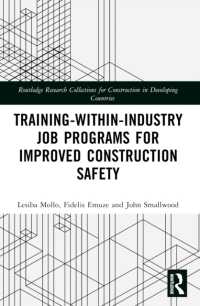
The purpose of this book is to demonstrate how a Training-Within-Industry (TWI) Job-Program could reduce human factor-related harm in construction.
The construction industry has a significant impact on issues relating to the health, safety, and well-being (HSW) of people in the workforce. It is important to acknowledge that workers' behaviour influences the safety management system (SMS) of construction projects either negatively or positively and that it is important for a management team to identify relevant behaviours and take appropriate action to solve problems. In most cases, accidents happen because of the results of human failure in the form of errors, violations and system failures. Human failure causes accidents and site management needs to reduce hazards that might cause such errors, violations and system failures on worksites. The chapters in the book address factors causing human failure on construction sites, how to mitigate errors and violations through SMS and 'learning by doing' and improving practice of using safety instructors on sites. The book closes with insights from a TWI-informed human failure reduction framework.
This book provides valuable insights into safety management in a construction site context that can be applied to other areas. It is essential reading for safety managers, construction managers, researchers, and advanced students.
Contents
Chapter 1. Construction safety and training-within-industry. 1.1. Introduction. 1.2. Training-within-Industry (TWI) method. 1.3. Research Methods. 1.4. Results. 1.5. Discussion. 1.6. Chapter Summary. References. Chapter 2. Causes of human failure on construction sites. 2.1. Introduction. 2.2. Human failure in industrial workplaces. 2.3. Research Methods. 2.4. Results. 2.5. Discussion. 2.6. Chapter Summary. References. Chapter 3. Human failure and safety management systems. 3.1. Introduction. 3.2. Safety management system in construction. 3.3. Research methods. 3.4. Results. 3.5. Discussion. 3.6. Chapter Summary. References. Chapter 4. Minimising human errors with learning-by-doing. 4.1. Introduction. 4.2. Learning-by-doing in industrial environments. 4.3. Research Methods. 4.4. Results. 4.5. Discussion. 4.6. Chapter Summary. References. Chapter 5. Managing health and safety on construction sites. 5.1. Introduction. 5.2. Safety managers and their function on construction sites. 5.3. Research methods. 5.4. Results. 5.5. Discussion. 5.6. Chapter Summary. References. Chapter 6. Minimising human errors on construction sites. 6.1. Introduction. 6.2. Training-Within-Industry method revisited. 6.3. Research methods. 6.4. Results. 6.5. Discussion. 6.6. Chapter Summary. References.